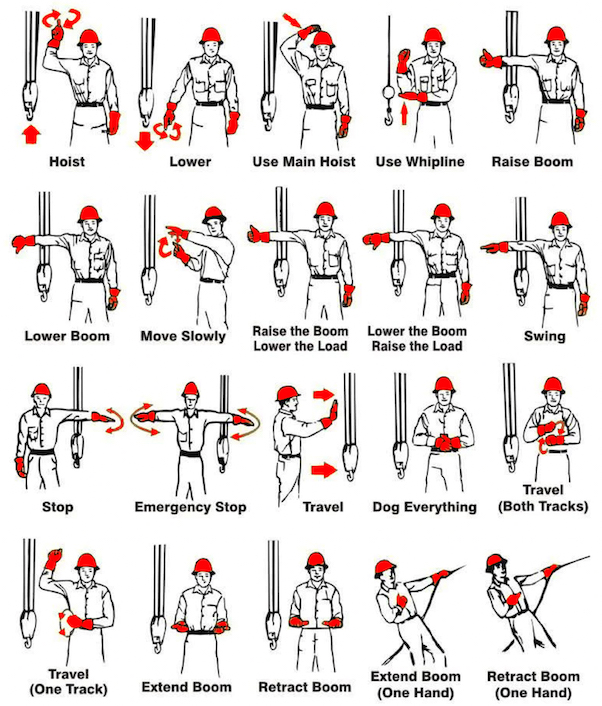
Hand signal charts must be either posted on the equipment or conspicuously posted in the vicinity of the hoisting operations.
Crane Hand Signals OSHA Requires
The crane hand signals OSHA accepts under 1926.1419 are the Standard Method shown on the chart above. The operator and the signal person must agree on the signals before work begins, only one person may give signals at a time, and the signal person must be qualified under 1926.1428. A stop or emergency stop signal is the exception: the operator must obey it no matter who gives it.
- Hoist - forearm vertical, forefinger pointing up, hand moving in a small horizontal circle.
- Lower - arm extended downward, forefinger pointing down, hand moving in a small horizontal circle.
- Raise boom (boom up) - arm extended out to the side, fingers closed, thumb pointing up.
- Boom down crane signal (lower boom) - arm extended out to the side, fingers closed, thumb pointing down. The boom down crane signal tells the operator to bring the boom down, which lowers the boom angle and carries the load farther out from the machine. Because a longer radius lowers what the equipment can safely pick, the operator must check the load chart before following it - see maximum load.
- Swing - arm extended, finger pointing in the direction the boom is to swing.
- Stop - arm extended, palm down, arm swung back and forth.
- Emergency stop - both arms extended, palms down, arms swung back and forth.
- Dog everything - hands clasped in front of the body.
- Extend boom / retract boom - both fists in front of the body, thumbs pointing outward to extend, thumbs pointing toward each other to retract.
- Move slowly - one hand held still in front of the hand that is giving the motion signal.
Hand signals are not the only choice. Voice signals have their own requirements in 1926.1421, and radio, telephone or other electronic signals are covered in 1926.1420. When the equipment is working near energized lines, the signal person also keeps the operator outside the distances in the OSHA power line clearance chart.